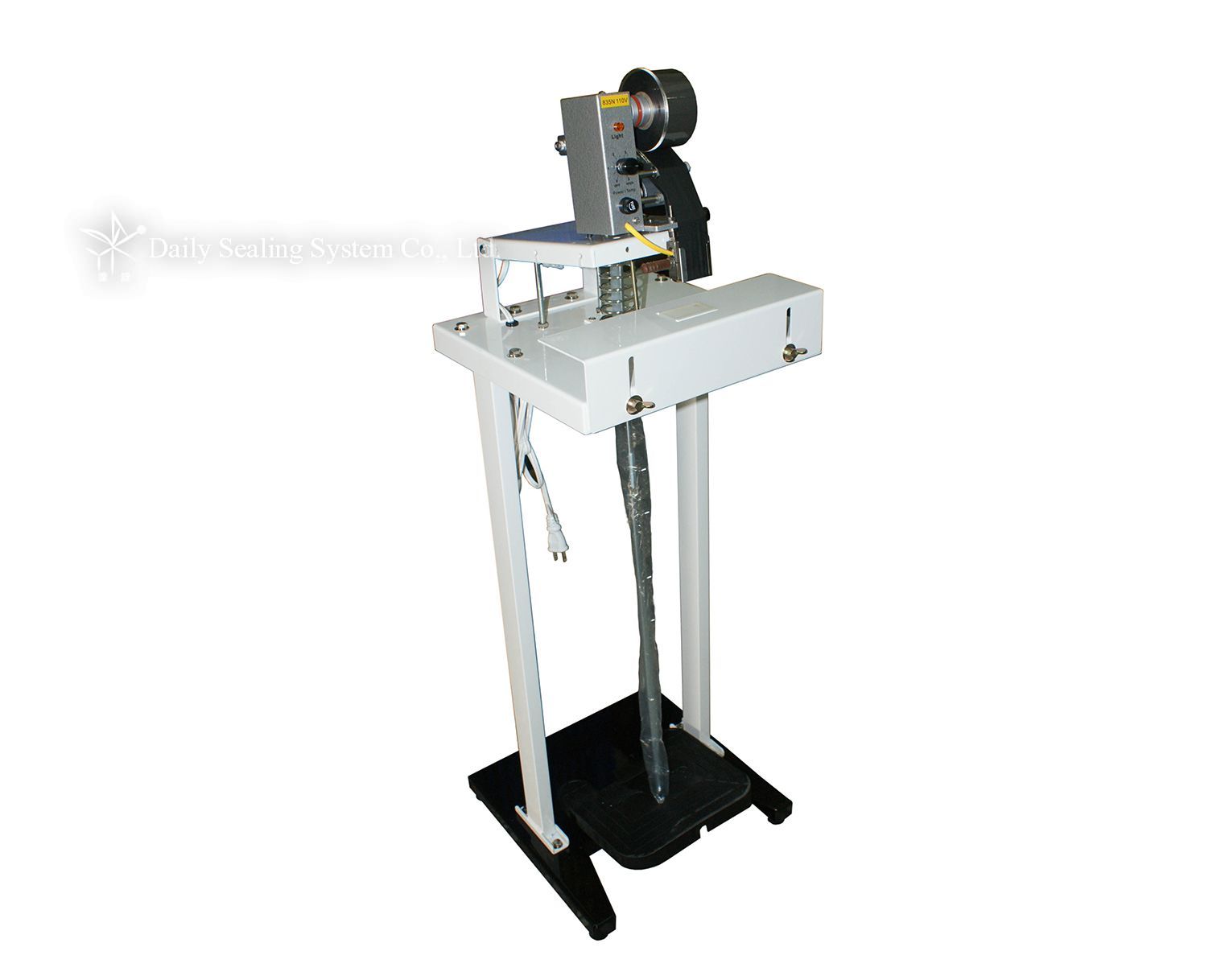
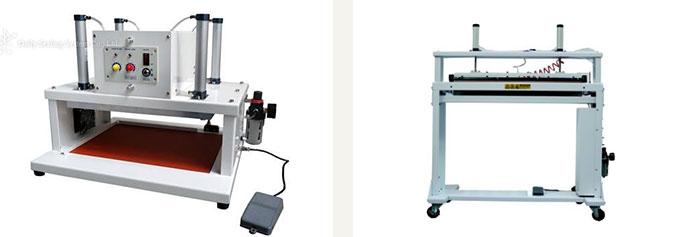
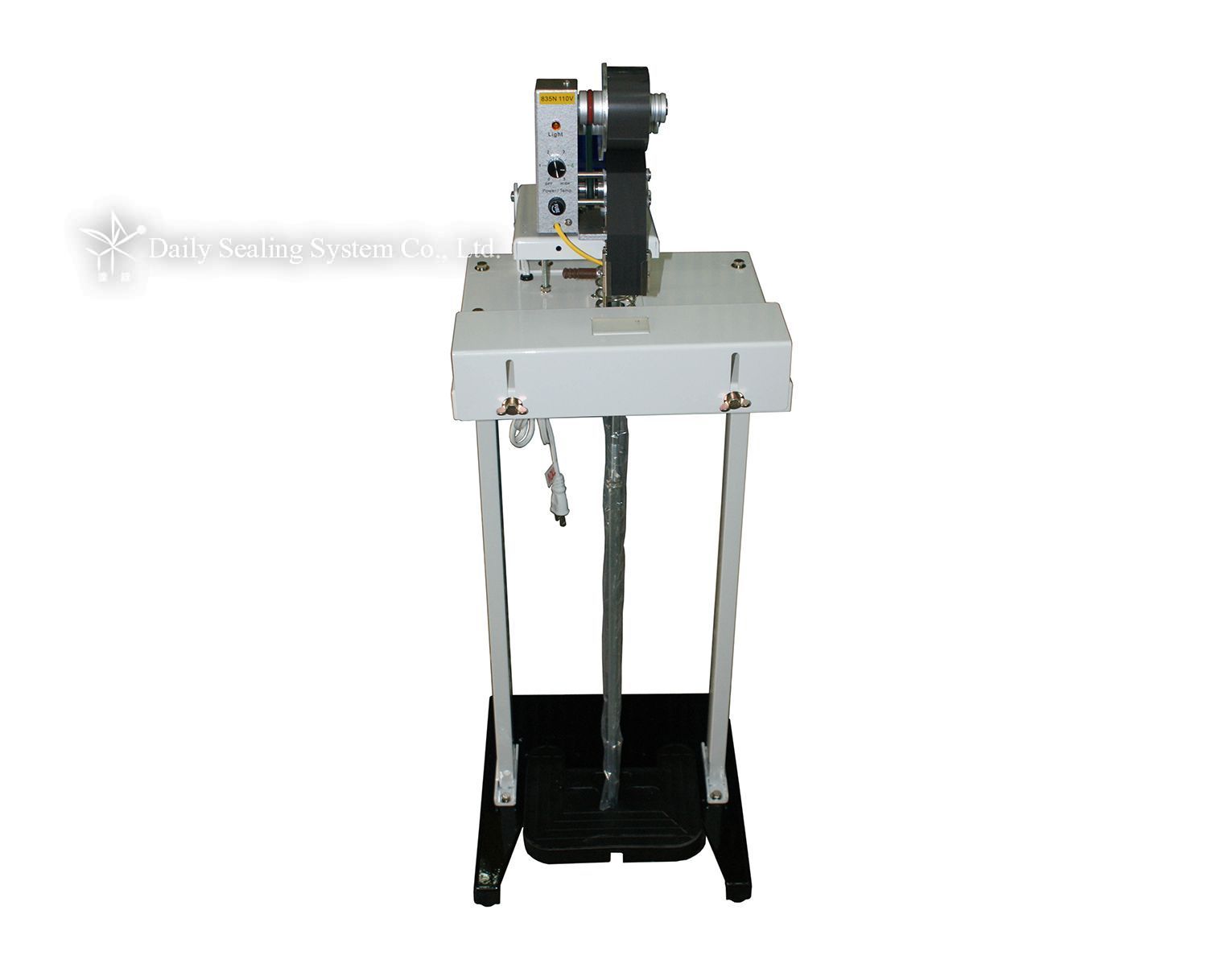
DP-8F-35 Hand Type Date Coding Machine
DS-8F-35
Foot Type Date Coding Machine

Made in Taiwan.

3 printing lines and can put 13 letters per printing line.
  • Detail
  • Feature
  • Video

Foot Type Date Coding Machine:

• Made in Taiwan.

• Option of letter setting, changeable of printing direction.

• Printing letters including MFG、LOT、EXP…etc.

• Option of printing lines from 1 to 3.

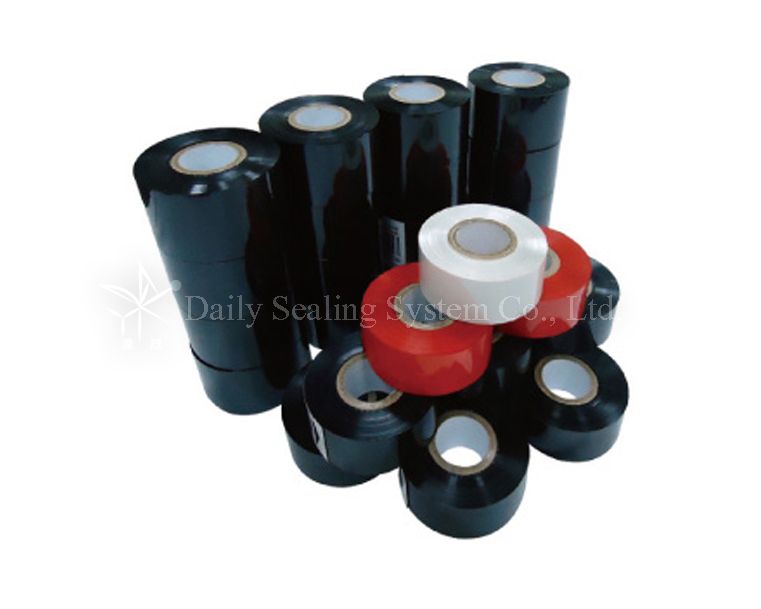
• Durable of color tape, not easy to discolor.

• Have the coding foil for frozen food using.

• Could be custom made the painting letters, such as company name.

• Suitable for cartons and plastic bag: made of PE, OPP, PVC, aluminum, tinfoil...etc.

• Option:

   (1) Added: pneumatic control (air control)

   (2) Or added: electromagnet control (auto control).

• One set unit including:

   (1) Dating imprinter x 1 set

   (2) Painting letter set x 1 box: 0~9, 0. ~ 9. , MFG, EXP, LOT.

   (3) Black ribbon foil x 1 roll

   (4) Manual operation x 1 set


Specification
Model No. DS-8F-35
Sealing type
Type
Voltage/Ampere 110V, 220V
Power
Vacuum capacity
Max.sealing
Vacuum time
Sealing time
Cooling time
Machine weight 11.70 kgs
Machine size 340 x 340 x 1020 mm
Vacuum flow
Pump capacity
Pump type
Chamber size
Sealing width
Sealing and conveyor speed
Bag total thickness
Bag size
Sealing Temperate
Conveyor width
Conveyor height adjusting range
Conveyor loading weight
Machine size
Packing
Warm up time
Heating
Temperature
Adjusting height of working table
Width of ribbon 35mm
Size of letter 4TC:4.0 x 2.5 mm( H x W )
Number of letters 3 lines, 13 letters per line
Printing area 8 x 32 mm( H x W )
Size of metal bar
Quantity of knives
Length of knives
Max. consumption electric power
Oscillation frequency
Max. welding
Film position
Size of heating board
Max. size of film
Inner core
Packing size
Working table size
PS2
PS3
Certification
Machine material
Suitable material of bag
Suitable for packing products
Spare parts
Warranty
Origin

Foot Type Date Coding Machine:

You May Also Like
Why Choosing Dailysealing
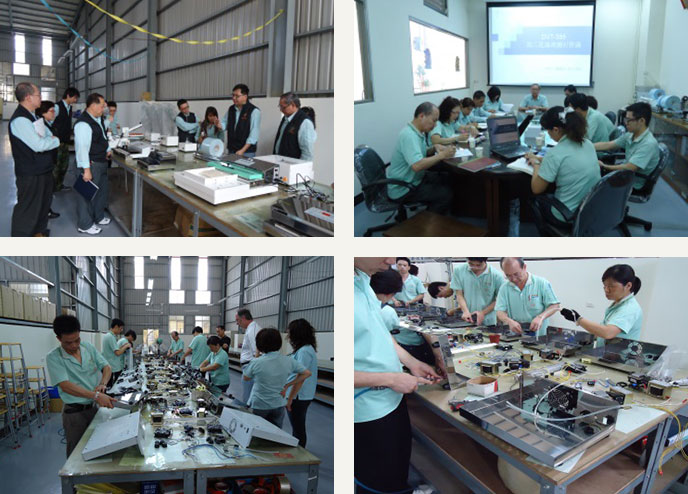
Parts and material quality control
  • Heating elements are from Japan.
  • Motor, Transformers, PCB and vacuum bags are made in Taiwan.
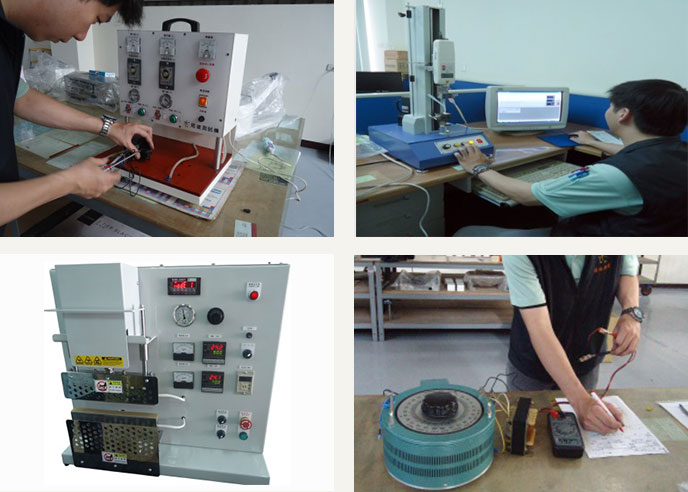
Strict quality control
  • 100% product inspection: The inspection is included functions and appearance of sealing machines.
  • Tensile strength test to ensure the sealing line tensile strength value reaches the customer standard.
  • Electric leakage test: Puncture and insulation test.
  • Our production and inspection are all based on ISO 9001.
Professional packaging and sealing machine factory
  • Produce many kinds sealing machines and ODM/OEM products and provide custom-made services.
  • More than 30 year experiences in packaging machines industry.
  • Sell sealing machines to America, Europe, Latin America and Asia.
  • 85% products in stocks, so we can deliver the products quickly.
  • The production process is based on SOP to ensure the quality of sealing machines consistently.
Complete range of specifications of sealing machines
  • Complete range of specifications of sealing machines.
  • Many kinds of sealing machines and consumptive materials in stocks, so customers can do one-stop shopping here.
  • The customers include Biotechnology companies, Medical equipment companies, Food industry, Electronics industry, Handmade soap industry and other industry..
Custom-made sealing machine service
  • Custom-made sealing machine service
  • Designs of the special sealing machine for irregular shape sealing line, such as U-shape sealing line and L-shape sealing line.
  • Different width of sealing line could be custom-made to meet customer requirements.
After-sales service of professional sealing machine
  • Provide the professional service for repair the broken sealing machine immediately.
  • The sufficient supply of parts stock, so don’t worry about the parts replace.
  • Some parts of sealing machine are used in common specifications, so it is easy to get the parts for replace.
Exhibitions and trade shows
News
How to Use a Vacuum Sealer?
2024/5/15
How to Use a Vacuum Sealer?
A vacuum sealer is a device widely used in food preservation, electronic product packaging, and other scenarios requiring the removal of air from the packaging. It effectively extends the shelf life of food, reduces microbial growth in the air, and maintains product freshness. Below, we'll explain step-by-step how to use a vacuum sealer, helping you master this skill with ease.   How to Use a Vacuum Sealer 1: Preparation First, ensure your vacuum sealer is properly installed and connected to a power source. Choose a vacuum sealing bag that fits the item you need to package. Different items may require bags of different sizes or materials. How to Use a Vacuum Sealer 2: Place the Item Place the item you want to seal evenly inside the vacuum bag. Make sure not to exceed the bag's maximum capacity and leave enough space at the opening of the bag so the vacuum sealer machine can seal it effectively.   How to Use a Vacuum Sealer 3: Vacuum and Seal Open the lid of the vacuum sealer and place the opening part of the vacuum bag smoothly on the machine's sealing area. Depending on the model, you may need to manually or automatically close the lid. Select the vacuum and sealing settings suitable for your item (if the machine offers multiple settings), then start the vacuum machine. The vacuum machine will automatically remove the air from the bag and seal it.   How to Use a Vacuum Sealer 4: Finishing Once the sealing is complete, the vacuum machine will signal or automatically open the lid. At this point, you can remove the now-sealed bag. Your item is now successfully packaged using a vacuum sealer and ready for storage or transport.   How to Use a Vacuum Sealer Tips - Before using the vacuum sealer, check if the bag is damaged or has holes to ensure effective sealing. - For foods with high moisture content, consider pre-freezing them to prevent moisture from being drawn out during the vacuum process, which could affect the sealing quality. - Regularly clean and inspect your vacuum sealer to ensure its long-term effective operation. How to Use a Vacuum Sealer?
MORE
What is Impulse Sealer Heating Element?
2024/11/5
What is Impulse Sealer Heating Element?
  What is Impulse Sealer Heating Element?   A Heating Element is a key component in impulse sealers, which are devices used to seal plastic bags and other thermoplastic materials. Here are the main points about this element:   Function: The heating element generates heat when an electrical current passes through it, which melts the thermoplastic material to create a seal.   Material: The heating elements are typically made from a nichrome wire (an alloy of nickel and chromium) because of its high resistance to electricity and ability to withstand high temperatures without breaking down.   Operation: In impulse sealers, the heat is only generated when the sealer is in operation (i.e., when the handle is pressed down), which means the wire is only heated for short periods. This helps prevent the wire from overheating and extends its lifespan.   Replacement: Over time, the heating element can wear out due to repeated heating and cooling cycles. It may need to be replaced to maintain the sealer's effectiveness.   Installation: Replacing the heating element typically involves removing the old one, cleaning the sealing bar, and then carefully installing the new one to ensure it is taut and properly positioned.   This component is crucial for the proper functioning of impulse sealers, widely used in packaging industries to ensure seals.
MORE
Vacuum Sealer Bags 101: Can I Reuse Them & What Bags Work with My Machine? (Vacuum Sealer
2025/12/24
Vacuum Sealer Bags 101: Can I Reuse Them & What Bags Work with My Machine? (Vacuum Sealer
Vacuum Sealer Bags 101: Can I Reuse Them & What Bags Work with My Machine? (Vacuum Sealer Bags, Consumables)   The bags you use are the most important consumables for your vacuum sealer. Understanding the different types and reuse rules can save you money and ensure a perfect seal every time.   Can I Reuse Vacuum Sealer Bags? The short answer is yes, sometimes, but with a big safety caveat.   When to Reuse: If the bag contained clean, low-odor, cooked, or dry foods (like baked goods, nuts, or leftover pasta), you can often wash, dry, and reuse the bag. Just make sure to cut the original seal cleanly and ensure the bag is completely dry before re-sealing.   When NOT to Reuse (Safety First): Never reuse bags that have contained raw meat, poultry, fish, or greasy/oily foods. Even after washing, there is a risk of cross-contamination and the residue may compromise the next seal. When in doubt, use a new bag.   Which Bag Type Do You Need? The type of bag you buy depends entirely on the type of vacuum sealer you own:   Vacuum sealer embossed and channel bags (For non-nozzle type vacuum sealer):   non-nozzle type vacuum sealer (the most common type, where the bag sits outside the machine) require bags with a special texture or channels inside. This texture allows the air to be successfully drawn out of the bag and past the sealing area.   Smooth Bags (For Nozzle Type Vacuum Sealer and Chamber Vacuum Sealers):   Chamber vacuum sealers work by removing all air from a chamber where the bag is fully enclosed. Because of this, they can use more economical smooth bags that lack the internal texture.   Make sure you are purchasing the correct vacuum sealer bags for your machine, as using a smooth bag in a non-nozzle type vacuum sealer will result in a complete vacuum failure.
MORE
TOP
We use cookies to provide a better experience. By proceeding, you agree to our PRIVACY POLICY, including the use of cookies and other tracking technologies.ACCEPT