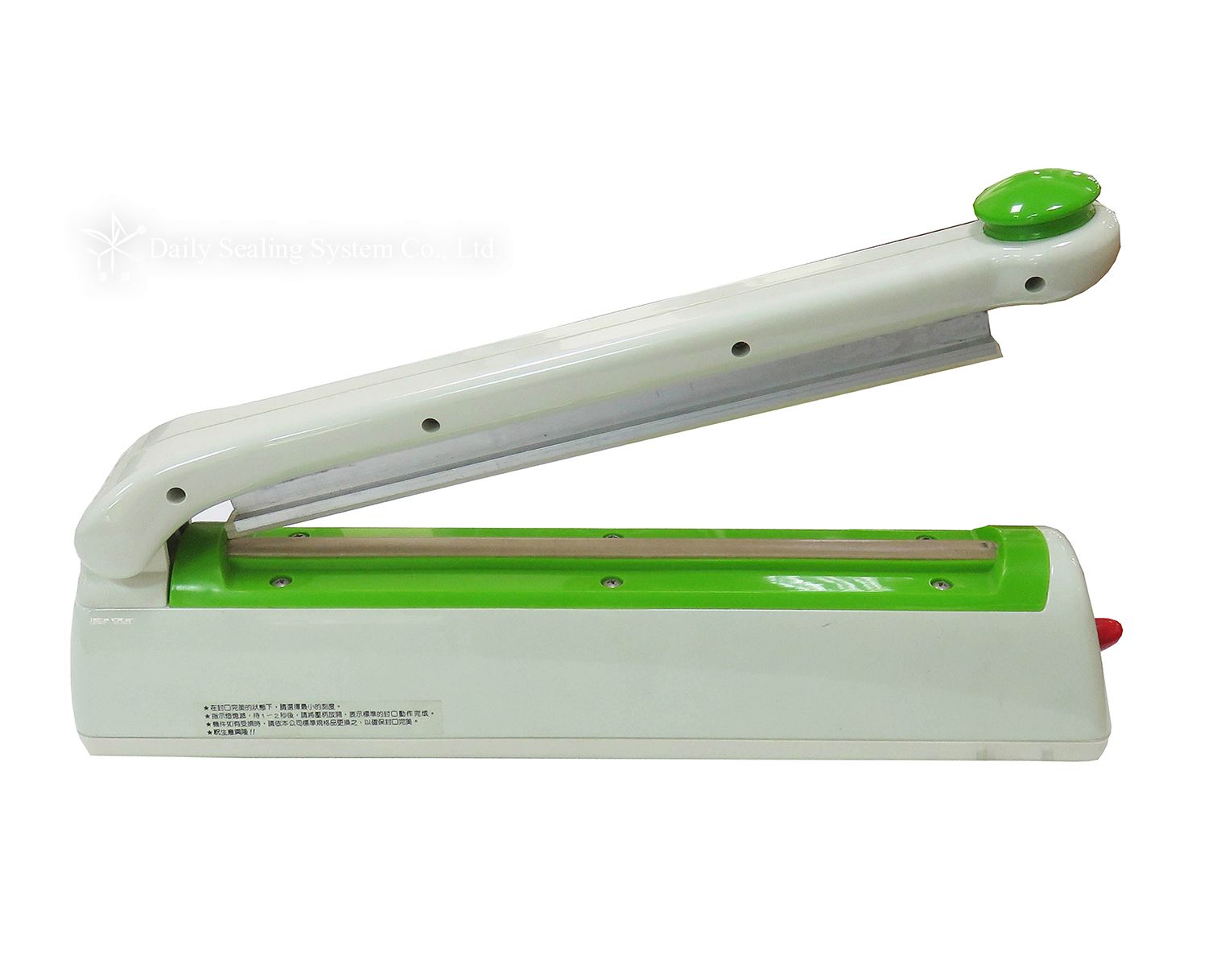
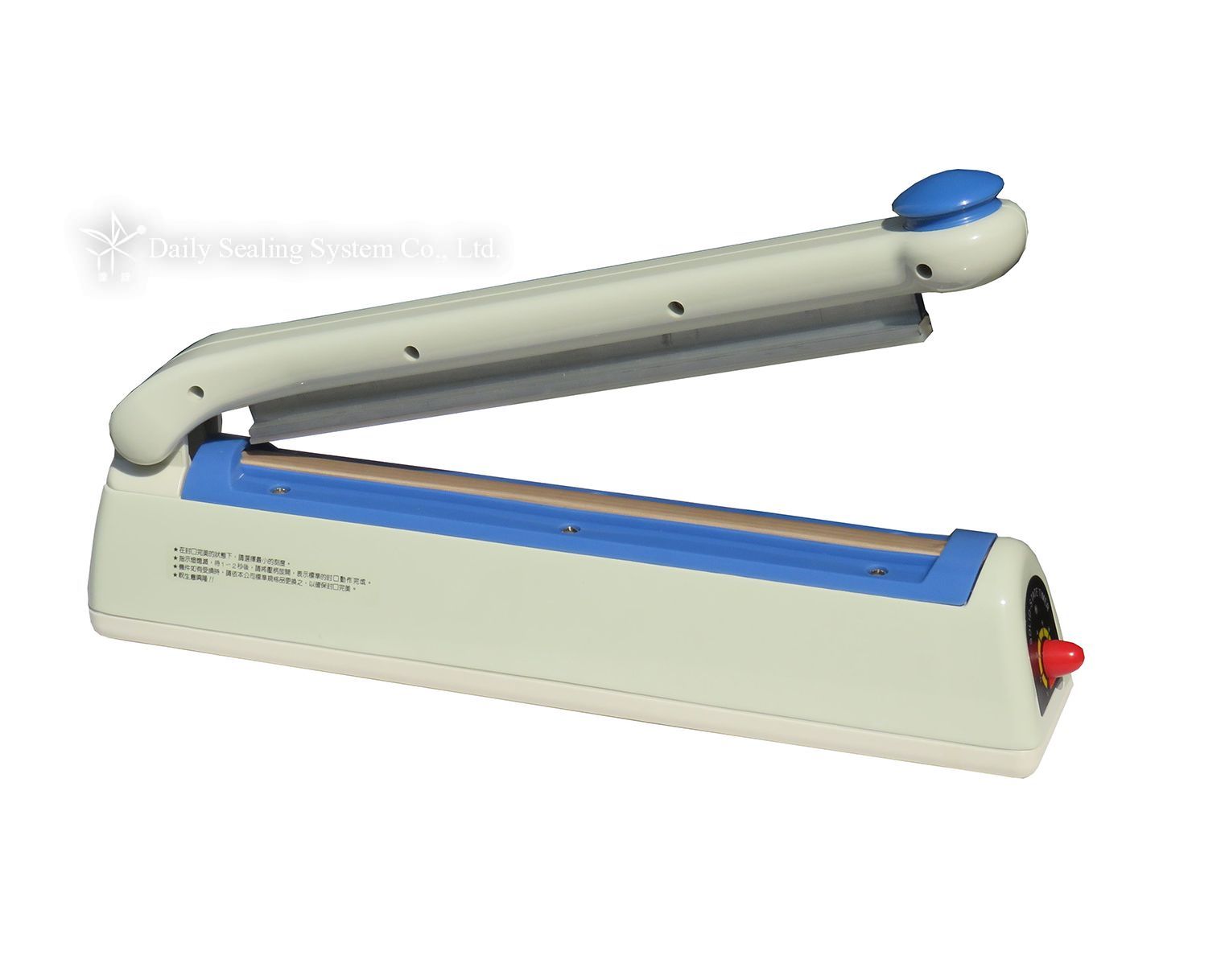
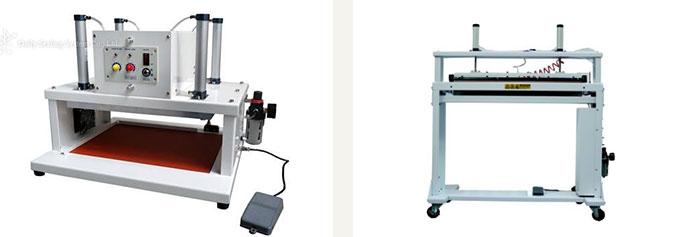
Sealing length: 20cm. Suitable material for kinds of plastic bags (PE, PP, OPP, PVC, OPF, NY), non-woven bag, thin alum. bags.
Why Choosing Dailysealing
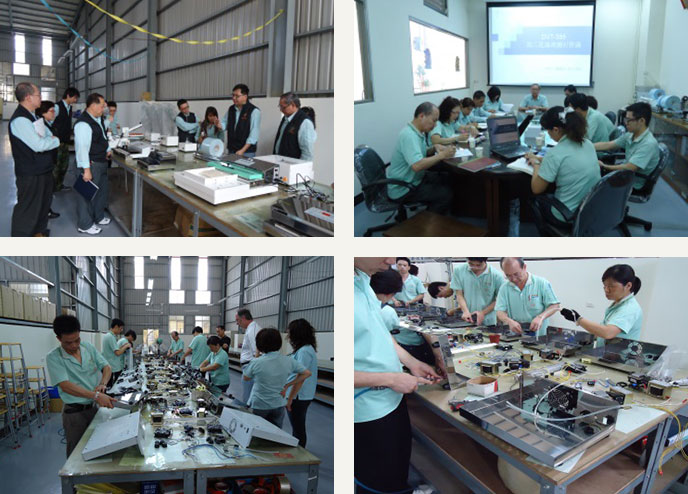
Parts and material quality control
Heating elements are from Japan.
Motor, Transformers, PCB and vacuum bags are made in Taiwan.
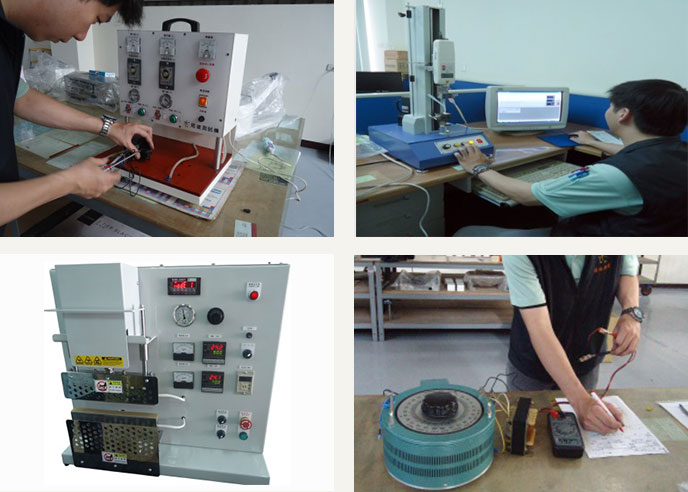
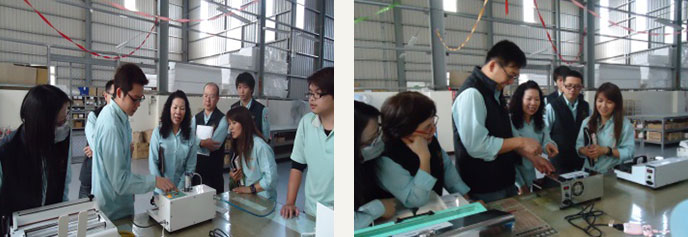
Strict quality control
100% product inspection: The inspection is included functions and
appearance of sealing machines.
Tensile strength test to ensure the sealing line tensile strength
value reaches the customer standard.
Electric leakage test: Puncture and insulation test.
Our production and inspection are all based on ISO 9001.
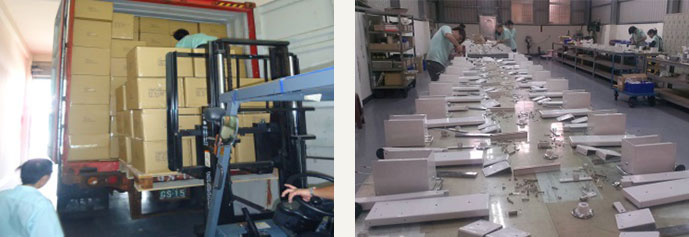
Professional packaging and sealing machine factory
Produce many kinds sealing machines and ODM/OEM products and provide
custom-made services.
More than 30 year experiences in packaging machines industry.
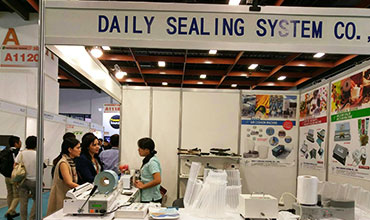
Sell sealing machines to America, Europe, Latin America and Asia.
85% products in stocks, so we can deliver the products quickly.
The production process is based on SOP to ensure the quality of
sealing machines consistently.
Complete range of specifications of sealing machines
Complete range of specifications of sealing machines.
Many kinds of sealing machines and consumptive materials in stocks,
so customers can do one-stop shopping here.
The customers include Biotechnology companies, Medical equipment
companies, Food industry, Electronics industry, Handmade soap
industry and other industry..
Custom-made sealing machine service
Custom-made sealing machine service
Designs of the special sealing machine for irregular shape sealing
line, such as U-shape sealing line and L-shape sealing line.
Different width of sealing line could be custom-made to meet
customer requirements.
After-sales service of professional sealing machine
Provide the professional service for repair the broken sealing
machine immediately.
The sufficient supply of parts stock, so don’t worry about the parts
replace.
Some parts of sealing machine are used in common specifications, so
it is easy to get the parts for replace.
Vacuum Sealer Bags 101: Can I Reuse Them & What Bags Work with My Machine? (Vacuum Sealer Bags, Consumables) The bags you use are the most important consumables for your vacuum sealer. Understanding the different types and reuse rules can save you money
and ensure a perfect seal every time. Can I Reuse Vacuum Sealer Bags? The short answer is yes, sometimes, but with a big safety caveat. When to Reuse: If the bag contained clean, low-odor, cooked, or dry foods (like baked goods, nuts, or leftover pasta),
you can often wash, dry, and reuse the bag. Just make sure to cut the original seal cleanly and ensure the bag is completely dry before re-sealing. When NOT to Reuse (Safety First): Never reuse bags that have contained raw meat, poultry, fish, or greasy/oily
foods. Even after washing, there is a risk of cross-contamination and the residue may compromise the next seal. When in doubt, use a new bag. Which Bag Type Do You Need? The type of bag you buy depends entirely on the type of vacuum sealer you own: Vacuum
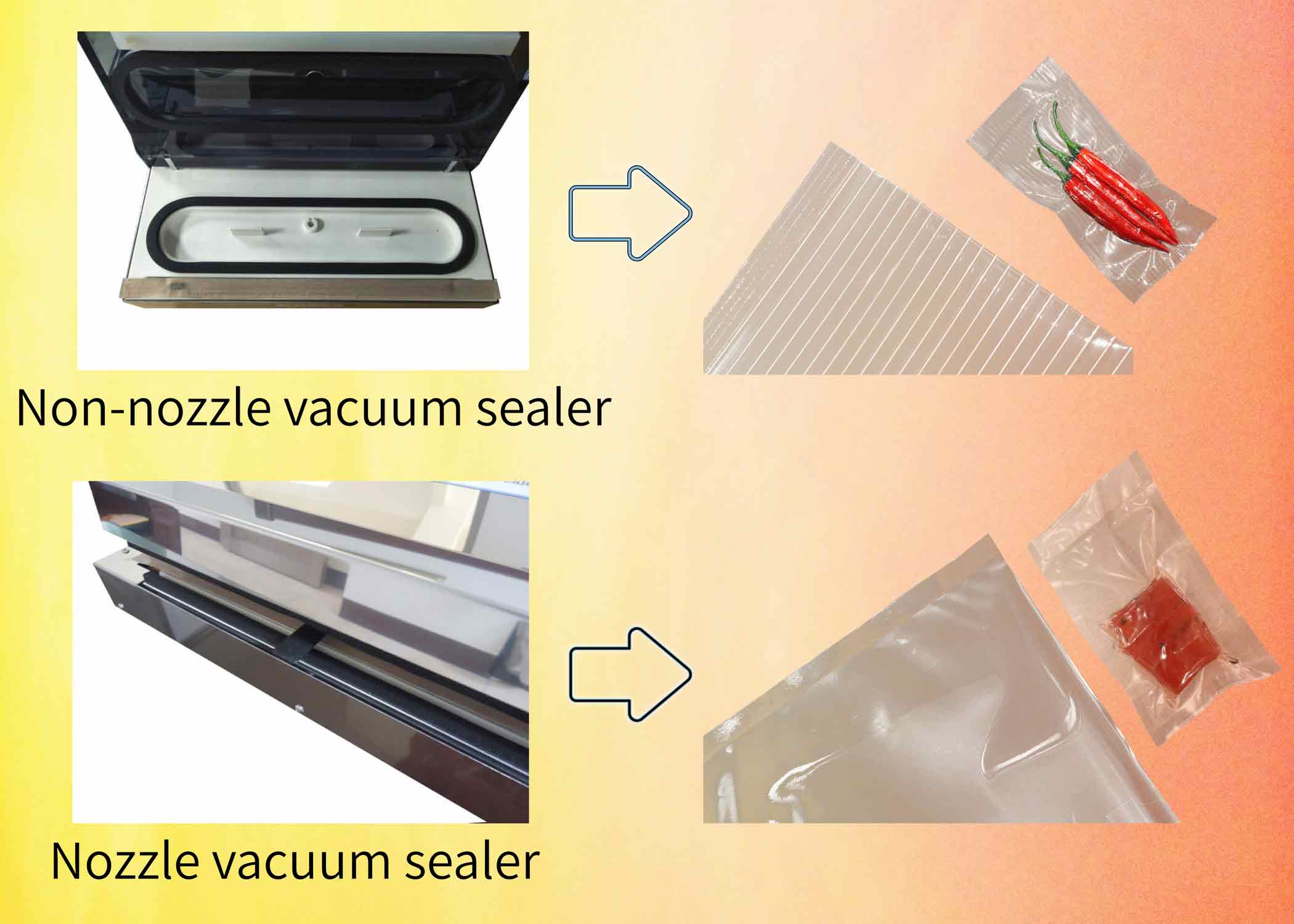
sealer embossed and channel bags (For non-nozzle type vacuum sealer): non-nozzle type vacuum sealer (the most common type, where the bag sits outside the machine) require bags with a special texture or channels inside. This texture allows the air to be successfully
drawn out of the bag and past the sealing area. Smooth Bags (For Nozzle Type Vacuum Sealer and Chamber Vacuum Sealers): Chamber vacuum sealers work by removing all air from a chamber where the bag is fully enclosed. Because of this, they can use more economical
smooth bags that lack the internal texture. Make sure you are purchasing the correct vacuum sealer bags for your machine, as using a smooth bag in a non-nozzle type vacuum sealer will result in a complete vacuum failure.
Commercial vs Household Vacuum Sealers: Which One is Right for Your Business? One of the most common questions buyers ask when sourcing a vacuum sealer is: "Should I get a commercial or household model?" The difference between commercial and home vacuum
sealers goes far beyond price — they differ significantly in usage frequency, vacuum consistency, seal quality, machine durability, and operational capacity. Choosing the wrong type leads to packaging inefficiency, higher maintenance costs, and a shorter equipment
lifespan. This guide breaks down exactly when to upgrade to a commercial vacuum sealer for your business. Quick Answer: Commercial vs Home Vacuum Sealer — How to Choose If you're packaging for household use or occasional small batches, a household vacuum sealer
may be sufficient. However, if you're running a food business, restaurant, processing operation, or e-commerce packaging line with consistent daily volume, a commercial vacuum sealer is the right choice for long-term reliability and output quality. Food Business
Restaurant Prep Food Processing High-Volume Packaging E-Commerce Fulfillment 1. Usage Frequency: Occasional Use vs. Daily Production Operations Household vacuum sealers are designed for light, infrequent use — portioning meat for the freezer, preserving fresh
produce, or occasional meal prep. They are not built for sustained operation. Commercial vacuum sealers are engineered for daily or continuous use in food production environments. Whether it's a vacuum sealer for restaurant operations, a central kitchen, a
food processing facility, or a packaging business, commercial-grade machines maintain consistent performance under high-frequency workloads where household units would degrade quickly. How to choose based on usage frequency: Occasional or low-volume packaging:
household or compact vacuum sealer Daily fixed-volume packaging: commercial vacuum sealer High-volume continuous production: chamber vacuum sealer or vacuum band sealer 2. Vacuum Performance: Commercial Units Deliver More Consistent Results Vacuum consistency
directly affects product shelf life and packaging integrity. Household models perform adequately for dry goods and standard freezer items. However, for high-moisture products, seafood, marinated meats, or applications that require a stronger, more reliable
vacuum level, commercial vacuum sealers outperform household units significantly. For food production, central kitchen operations, and vacuum sealer for food production vs home use comparisons, a Chamber Vacuum Sealer provides the stable, measurable vacuum
levels required for commercial-grade packaging. 3. Seal Quality: Commercial Machines Handle Demanding Materials and Higher Throughput Seal quality directly determines whether a package leaks, allows moisture ingress, or maintains its vacuum over time. Household
sealers can handle standard bag materials for basic applications, but may produce inconsistent seals under sustained operation or with thicker packaging materials. Commercial vacuum sealers feature more robust sealing bar construction and are compatible with
a wider range of bag materials — making them the preferred choice for food businesses, electronics packaging, medical consumables, and industrial applications where seal failure has real operational consequences. 4. Machine Durability: Heavy-Duty Vacuum Sealer
vs. Small Machine Household vacuum sealers prioritize compact form factor and ease of use for home storage. Commercial and heavy-duty vacuum sealers are built with more robust internal components, designed to withstand the mechanical stress of daily production
environments. Signs you need to upgrade to a commercial vacuum sealer: Daily packaging operations with fixed output requirements Processing large batch quantities in a single shift Seal quality directly impacts product shelf life or customer experience Packaging
heavier, thicker, or larger bag materials 5. Target Users: Household Prioritizes Convenience, Commercial Prioritizes Throughput Household vacuum sealers are designed for individual consumers who need simple, accessible food storage. Commercial vacuum sealers
are built for businesses that require reliable throughput, consistent seal quality, and equipment that scales with production demands. ComparisonHousehold Vacuum SealerCommercial Vacuum Sealer Primary Use Home food storage, small batches Food processing, restaurant,
commercial packaging Usage Frequency Occasional Daily or continuous production Vacuum Consistency Basic level Stable and measurable, suited for commercial use Seal Quality Standard bag materials Higher seal integrity, wider material compatibility Equipment
Cost Lower upfront cost Higher initial investment, lower long-term operating cost 6. Choosing the Right Vacuum Sealer for Your Business Scenario For home food storage or very low-volume prep, a compact household unit is a cost-effective starting point. But
for any business operation — restaurant, food producer, e-commerce packager, or small business with regular daily output — a commercial vacuum sealer provides the durability and consistency that household machines cannot deliver over time. Recommended direction
by business type: Home or personal use: compact vacuum sealer Restaurant or central kitchen: chamber vacuum sealer recommended Food processing or high-volume production: vacuum band sealer or continuous model Small business or e-commerce packaging: nozzle
or non-nozzle commercial vacuum sealer If you're evaluating models, browse the Vacuum Sealer Series to compare equipment types before deciding based on your product type and output volume. 7. Before Purchasing: 4 Key Questions to Answer 1. Daily Output Volume
Higher volume demands more durable commercial equipment with consistent throughput capacity. 2. Product Content Solid, liquid, powder, or high-moisture products require different vacuum sealing configurations. 3. Bag Material & Size Bag dimensions, thickness,
and material structure all affect sealing performance and vacuum results. 4. Long-Term Operating Cost Commercial machines carry a higher upfront cost but deliver lower cost-per-unit over sustained daily use. Dailysealing: Commercial Vacuum Sealer Supplier
for B2B Buyers Dailysealing is a professional vacuum sealer and sealing machine manufacturer with an in-house production facility and extensive experience in commercial packaging machinery. If you're unsure whether a commercial or household unit fits your
operation, our team can assess your product type, bag material, daily output, and operational requirements to recommend the most suitable vacuum sealing solution. Frequently Asked Questions Q1: Can a household vacuum sealer be used for commercial purposes?
Not recommended for sustained commercial use. Household vacuum sealers are designed for low-frequency, small-batch packaging. Using them at commercial volumes will degrade machine performance and shorten equipment lifespan significantly. Q2: Are commercial
vacuum sealers always more expensive than household models? Commercial machines carry a higher initial price, but their durability, vacuum consistency, and seal performance deliver lower long-term operating costs. For businesses with regular packaging needs,
the total cost of ownership typically favors a commercial unit. Q3: Is a commercial vacuum sealer necessary for restaurants? For low-volume prep, a household unit may work short-term. However, for daily large-batch ingredient portioning, refrigerated storage
management, or central kitchen distribution, a commercial vacuum sealer for restaurant use delivers the consistency and durability required for professional operations. Q4: What about vacuum sealers for small businesses or e-commerce packaging? For low and
irregular shipment volumes, a compact model may be sufficient. However, as daily order volume grows, or if packaging quality directly affects the customer experience, upgrading to a commercial vacuum sealer for small business use will reduce errors and improve
output consistency. Q5: When should I upgrade from a household to a commercial vacuum sealer? Consider upgrading when your daily packaging volume becomes consistent, when seal failures affect product shelf life or customer returns, or when your product type
(liquid, high-moisture, or thick bag material) exceeds the capability of your current household unit. Need Help Choosing the Right Vacuum Sealer for Your Business? Tell us about your product type, bag dimensions, daily output, and operating environment. Dailysealing
can help you evaluate the right commercial vacuum sealer for your packaging operation. View Vacuum Sealer Series Contact Us // //
Dear Sirs, By government guidelines on the Lunar New Year Festival, Daily Sealing will be closed for a vacation break from January 25 to February 02, 2025. We are very grateful for your patronage and collaboration in the past year, and would like to take
this wonderful opportunity to wish you Happy New Year of The Snake Yours truly, Daily Sealing System Co., Ltd.
We use cookies to provide a better experience. By proceeding, you agree to our PRIVACY POLICY, including the use of cookies and other tracking technologies.ACCEPT
(1).jpg)
(19).jpg)
.jpg)







.jpg)